What Is the Best Skip Tracing Service? 7 Top Picks
 Edited byJames Vasquez
What makes the best skip tracing service is less about the biggest database and more about whether the tool fits the subject you're tracing, the volume you're running, and the proof you need before outreach starts. A service built for U.S. companies and people can be the smartest choice for real estate, B2B sales, collections, or investigation work, but only if it also gives you usable phones, emails, addresses, and owner-level contact paths. That's why transparency matters. Some platforms publish self-serve pricing and no-match-no-charge billing, while others require contracts, credentialing, or quote-based onboarding. SkipForge stands out in this comparison because it combines company tracing, person tracing, owner contact discovery, bulk processing, and export-ready results in one workflow, which is exactly where many teams lose time.
1. SkipForge
SkipForge is a practical fit for buyers who need to trace people and companies in one workflow. It starts with the entity, moves to the officer or member, then ties that record to personal contact data so outreach can reach the person behind an LLC or other registered business. That matters in business prospecting, because company names and mailing addresses alone often do not reveal who can respond.
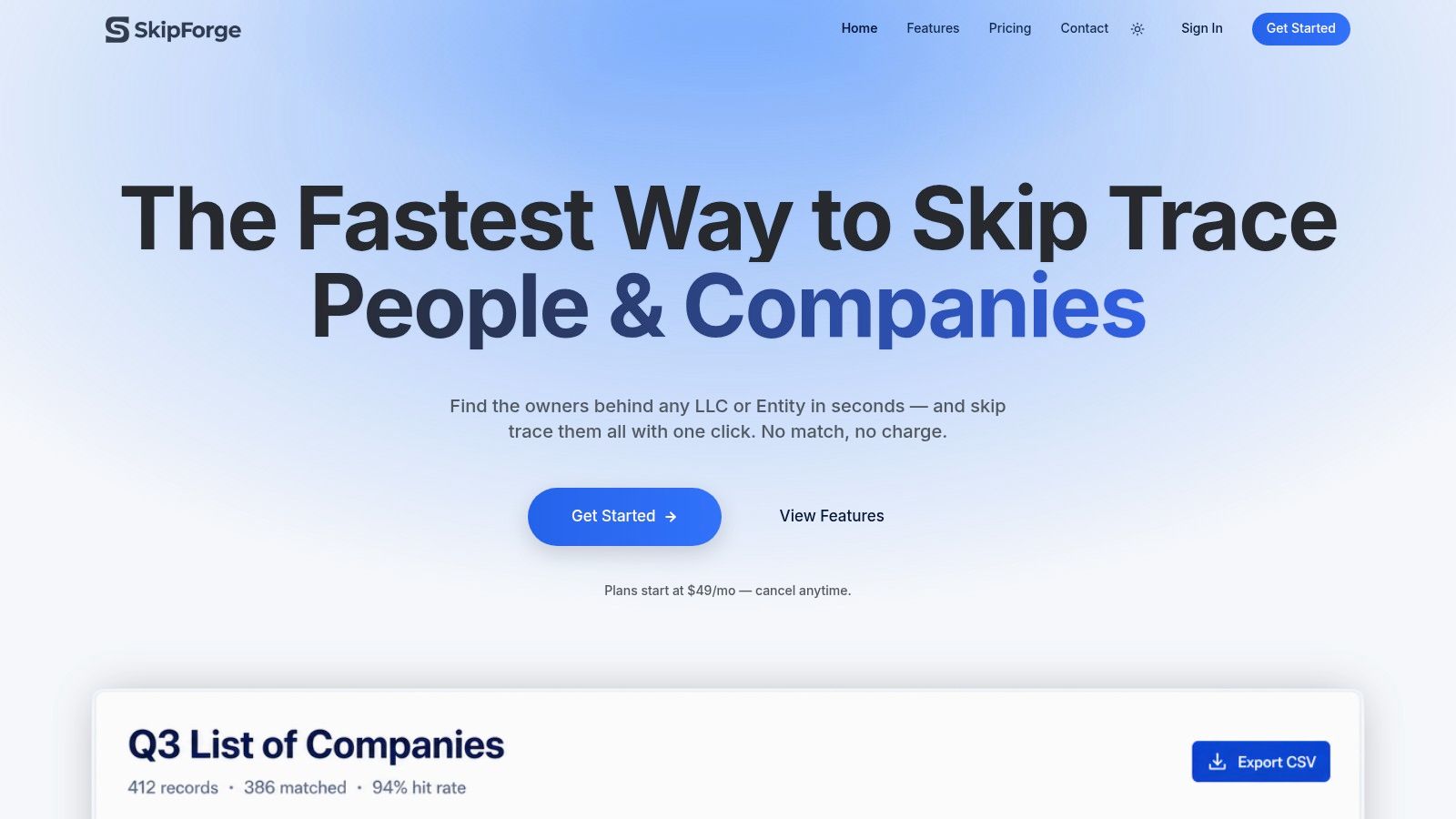
The workflow is built for bulk use. SkipForge supports CSV/XLSX uploads, automatic column detection, background processing, saved searches, and CSV exports that are ready for CRM or dialer import. For teams working U.S. records, that cuts down manual cleanup and reduces time spent calling obsolete numbers, which is a common problem in aging B2B lists.
Pricing and data depth
SkipForge is also unusually clear on cost. It offers pay-as-you-go credits with no monthly fee and a minimum credit top-up of $25, plus a Pro plan starting at $49/mo with included searches and lower per-search costs. The pay-as-you-go path lists an entity search at about $0.99 and a person search at about $0.20, while Pro lowers those to roughly $0.25 and $0.10. Purchased credits never expire, and the platform uses a no match, no charge policy, so billing only applies when results are returned. See the full pricing structure on the SkipForge pricing page.
Because the pricing is self-serve, it is easier to compare against other tools that require quotes, contracts, or credentialing before a team can test the workflow.
Practical rule: If you need to find the owner behind an entity and then export contact data for outreach, SkipForge keeps that process in one place.
Best fit
SkipForge fits real estate investors, B2B sales and lead-gen teams, collections and recovery agencies, private investigators, and marketing teams that want U.S. skip tracing without an enterprise setup. It is also a strong option for teams that need company/entity tracing and person tracing in the same system, instead of moving between separate databases.
2. Thomson Reuters CLEAR
Thomson Reuters CLEAR fits buyers who need investigation depth more than a lightweight self-serve tool. Its skip tracing workflows support people, phone, and address pivots, while link analysis and network mapping help teams connect individuals, businesses, and assets. For legal, financial, collections, and law-enforcement work, that broader view can matter more than a fast lookup.
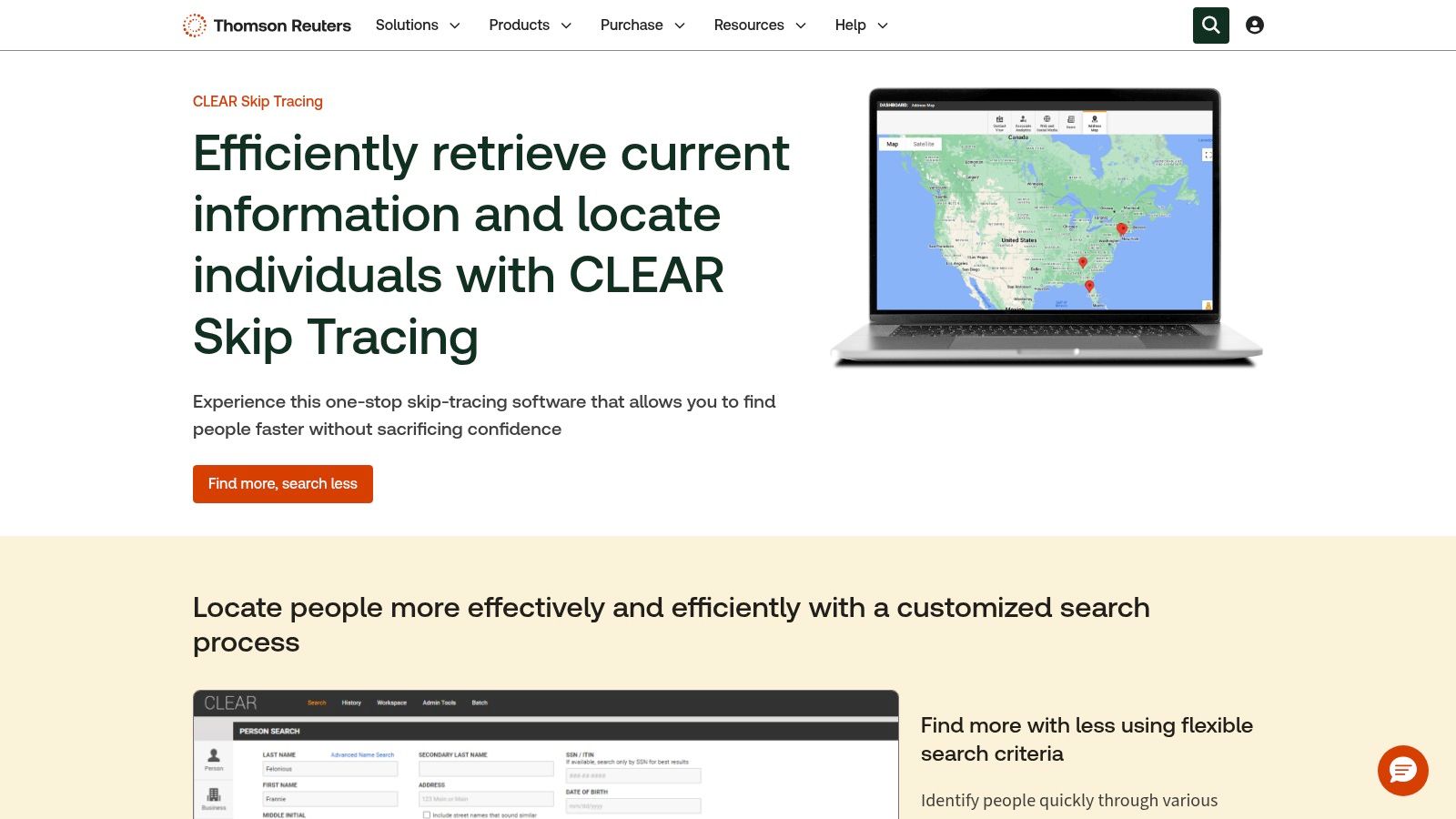
CLEAR can start from thin inputs, including a phone number in some searches, which helps when the record you have is incomplete. The platform also uses guided onboarding and role-based access, so it is better aligned with larger teams that need permissions, auditability, and internal controls than with a quick signup workflow.
What CLEAR gives you
CLEAR is strongest when the question is not only “can I find this person?” but also how the related records connect. Its network mapping and entity resolution are built for that kind of work, and the system is widely used in public- and private-sector investigations. Teams that need enterprise support, training, and compliance resources can use investigative research workflows that resemble this model, where process and oversight matter as much as search speed.
Where it falls short
Pricing is quote-based, so buyers lose the easy comparison they get from self-serve credit systems. Credentialing and permissible-use vetting are part of the purchase process, which is normal for this tier but still slows smaller operators. CLEAR makes sense when a matter is complex enough to justify contracting and onboarding, not when the goal is only quick owner contact discovery.
If your workflow depends on link analysis, guided access, and enterprise oversight, CLEAR is a stronger investigative platform than a lightweight skip tracing tool.
3. LexisNexis Accurint
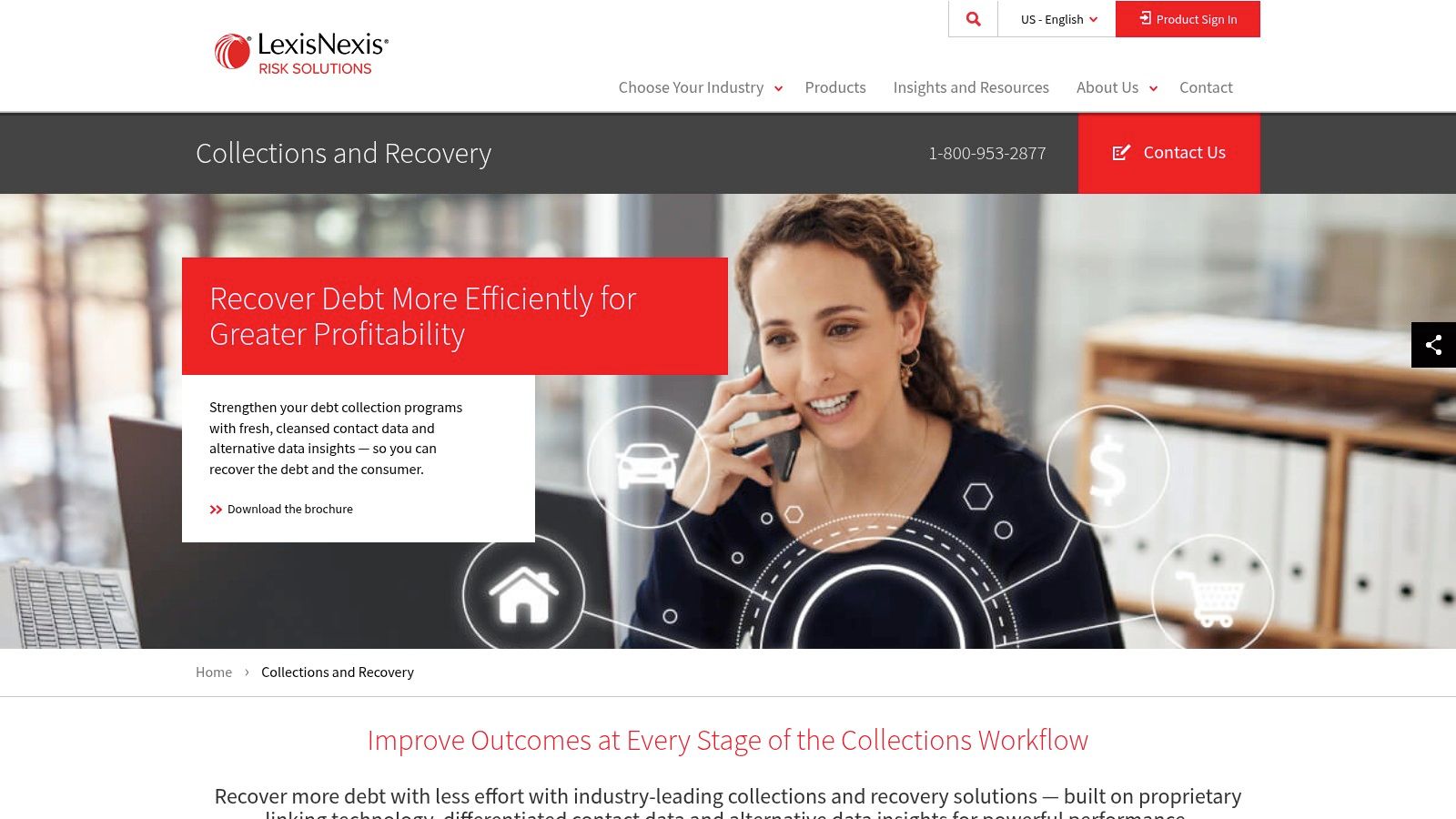
LexisNexis Accurint suits teams that need broad public-record coverage and structured batch processing. Its Contact & Locate and Deep Skip Search reports target hard-to-find subjects, so it fits collections and contact-locate work better than casual searches. That matters when a file list is large and the team needs repeatable search logic, not one-off lookups.
The main advantage is how it supports operational review. Batch delivery helps teams process more records at once, and the documented SKUs make it easier to match products to specific use cases. For collections and legal groups, that structure helps with procurement, reporting, and internal controls.
Pricing and workflow fit
Accurint works best for organizations that already have usage governance in place. Pricing may be flat-rate or transactional, but cost control still matters because per-hit fees can add up on large files. The interface can feel dense at first, yet experienced users often prefer the range of report types to a simpler front end. For teams building batch processing for collections (https://www.skipforge.com/blog/outrank-integration-test-article), that tradeoff can be acceptable if the workflow depends on repeatable searches and documented outputs.
Best fit
Choose Accurint for collections, contact locate, or large-volume batch work when your team can handle credentialing and spend controls. It is also a practical option when the job calls for public-record depth and report structure over ease of use.
4. TransUnion TLOxp
TLOxp is a strong pick for teams that want relationship insights and a broad investigative toolkit in one place. It delivers person, business, and asset search capabilities with relationship context, which is useful when right-party contact depends on more than a single phone number. For law enforcement, recovery professionals, and collections teams, that relationship layer can make the difference between a partial lead and a usable contact path.
TLOxp also offers multiple commercial pricing models, including transactional, per-seat, and flat-rate structures. That flexibility helps larger organizations align pricing with volume, but it also means onboarding can be stricter than with self-serve tools. In practice, TLOxp is often chosen by organizations that already have formal investigative workflows and credentialing processes.
Why teams choose it
The platform is well known in law enforcement and recovery circles, and its search depth is the main reason. It's the sort of service you use when you need detailed lookup reports rather than a fast one-off answer. If your work depends on business ownership clues, vehicle ties, property ties, and associated contacts, TLOxp sits in a deeper investigative class than consumer-style people search tools.
Main limitation
The onboarding friction is real. Transactional plans can also include a monthly minimum on certain plans, so the tool makes the most sense when your volume is consistent enough to absorb that structure. Use TLOxp when you need established investigative infrastructure and can meet the required access controls.
Use TLOxp when the case requires more than a contact record, especially when relationship data and asset context matter.
5. IDI idiCORE
IDI idiCORE is built around identity intelligence and recency, which is why it appeals to investigators and recovery teams that care about current signals. The platform emphasizes up-to-date contact and location data, map-based proximity tools, and vehicle or owner insights. That combination is especially relevant when a subject's location matters as much as the person's phone number.
idiCORE is not positioned like a casual lookup tool. It's more useful when your work has a field component, such as repossession or active locate work, and you need mapping support alongside contact intelligence. For public-sector users, mobile access can also be part of the appeal, though some advanced capabilities are gated by use case and qualification.
What makes it different
The platform's selling point is that it tries to surface actionable connections, not just static records. That's valuable when old contact data isn't enough and you need to know where someone might be or what nearby signals connect them to a property, vehicle, or business. In those workflows, recency beats raw record count.
Trade-offs to expect
Pricing is not publicly listed, so buyers should expect a quote-based conversation. Credentialing and permissible-use verification are also part of the process, which limits access but supports the platform's investigative positioning. Choose idiCORE when current-location intelligence and vehicle-centric tracing matter more than simple contact export.
6. Tracers
Tracers suits firms that need person and business searches, with enough flexibility to support both one-off lookups and higher-volume work. Its value is less about a flashy interface and more about how it fits legal, collections, and investigative workflows, especially for teams that need web access, batch processing, and an API. It also sits comfortably alongside legal-tech tools through integrations such as Clio.
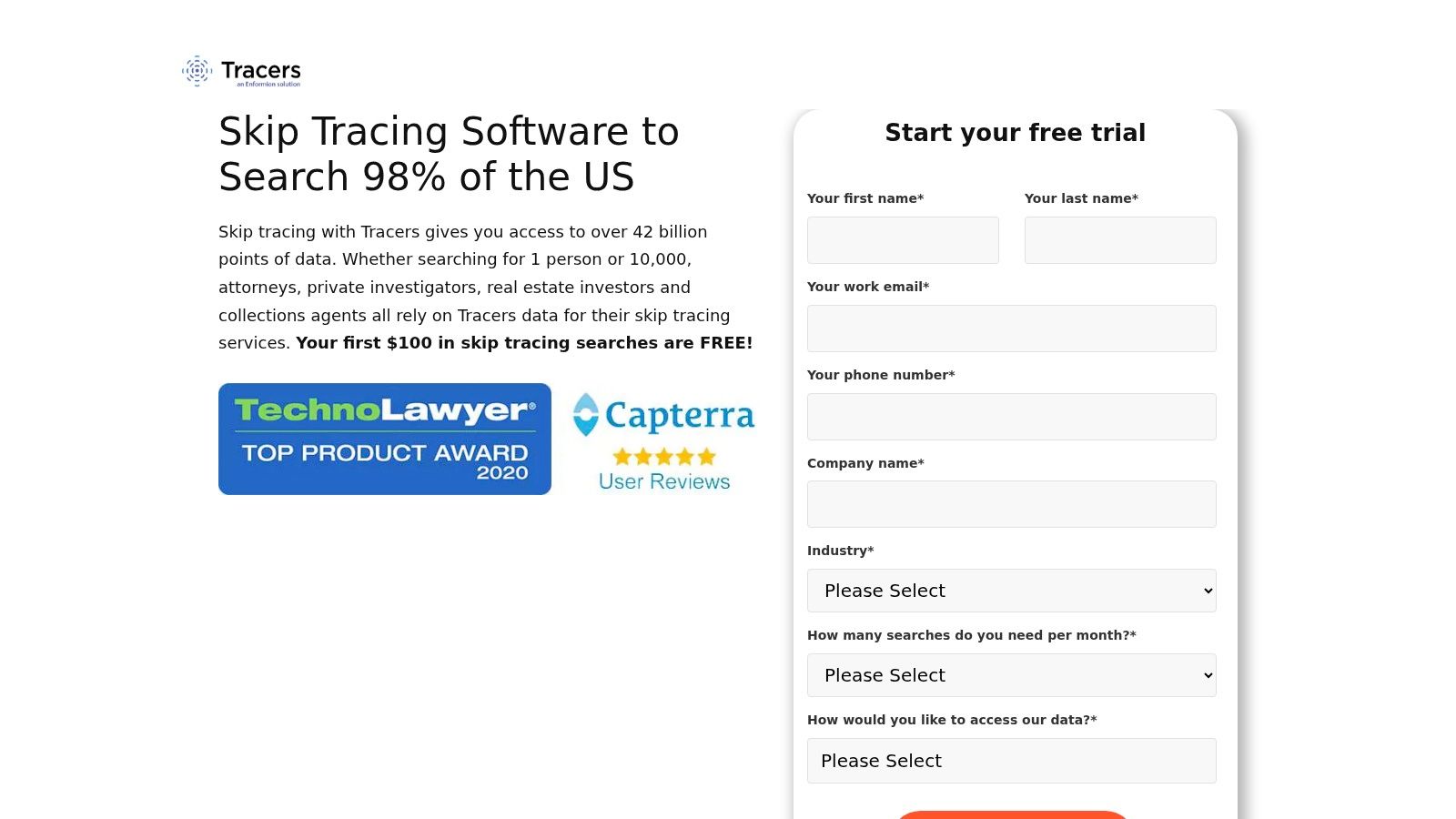
For buyers comparing coverage depth, the question is whether they need a broad search layer or a system built for repeated enrichment. Tracers works well in the second category, where case data has to move through an existing stack and bulk list processing matters as much as individual records. That makes it more practical for teams that want to combine manual review with automated workflows.
Pricing and access
Public pricing is not the point here. Tracers is typically sold around plan level and volume, with add-ons and premium data affecting the total, so buyers should confirm the exact structure before budgeting. Credentialing and permissible-use checks still apply, which keeps access oriented toward professional use.
Best fit
Use Tracers when you need batch processing, an API, and a legal-tech-friendly workflow without moving into the most restricted investigative platforms. It is a sensible fit for firms that value workflow integration and scale more than a highly polished front end.
7. Delvepoint
Delvepoint is a good fit for buyers who want pricing flexibility and an investigative toolset for collections, legal research, compliance, and repossession work. Its workflows surface phones, relatives, addresses, and bankruptcy information, which makes it useful when the search has both contact and recovery implications. For teams that need a more guided PI-style experience, Delvepoint can feel approachable without being simplistic.
What separates Delvepoint from many peers is the range of commercial models. It supports transactional, per-seat, and flat-rate packages, and buyers can also look for volume discounts and trials. That gives smaller and larger teams a way to test fit before they commit to a more permanent plan.
Where it works best
Delvepoint is strongest for users who value a user-friendly PI and collections workflow plus room to scale up later. Optional add-ons and integrations can be helpful in repossession-oriented processes, where one contact record often needs to feed multiple internal steps. It's not the deepest enterprise investigative suite in this list, but it is a flexible one.
Watch the terms
The transactional plan includes a monthly minimum, so buyers should confirm the current structure before budgeting around it. Some premium data or tools may also require extra qualification or fees. Use Delvepoint when you need a practical investigative database with multiple pricing paths and a service model that supports professional use.
Top 7 Skip Tracing Comparison
Tool 🔄 Implementation complexity 💡 Resource requirements ⭐ Expected outcomes 📊 Ideal use cases ⚡ Key advantages SkipForge Low, self-serve web UI with CSV bulk and minimal onboarding Low–moderate, pay-as-you-go credits or Pro subscription; U.S.-only High for U.S. entity/person matches; relatives/associates discovery Real estate investors, B2B lead-gen, collections, PIs, data enrichment Cost control, entity+person linking, fast single lookups + async bulk Thomson Reuters CLEAR Medium–high, enterprise onboarding, role-based access and vetting High, quote-based licensing, contracting and compliance checks Very deep investigative coverage and link/network analysis Law enforcement, financial services, legal/investigations teams Robust analytics, network mapping, enterprise support/training LexisNexis Accurint Medium, mature but dense interface; credentialing required High, per-hit fees and batch programs; careful cost controls needed Very comprehensive public-record linking and batch results Collections, contact & locate, high-volume operations Extensive coverage, documented report SKUs, strong batch capabilities TransUnion TLOxp Medium–high, onboarding/credentialing and configurable workflows Moderate–high, multiple pricing models (transactional, per-seat, flat) often with minimums Deep person/business coverage with relationship and asset insights Law enforcement, PIs, collections, recovery teams Flexible pricing, investigative toolset, wide industry adoption IDI idiCORE Medium, onboarding with gated advanced features for some users High, quote-based pricing; some capabilities restricted by qualification Timely contact/location signals, strong map/proximity and vehicle insights Repossession, vehicle-centric investigations, public-sector locates Recency-focused data, mapping/proximity tools, mobile support Tracers Low–medium, accessible UI, API and batch options; easier onboarding Moderate, simple pricing tiers; add-ons/premium data may add cost Broad U.S. coverage and scalable batch/API enrichment Law firms, private investigators, legal-tech integrations, bulk processing API & integrations, batch processing, approachable pricing Delvepoint Low–medium, PI/collections-oriented workflows and trials available Moderate, transactional/per-seat/flat options; monthly minimums possible Effective skip tracing and recovery-focused results with add-ons PI, collections, repossession and compliance research Pricing flexibility, user-friendly searches, volume discounts and trials Match the Service to Your Search Workflow
The best skip tracing service depends on what you're trying to trace and how your team works. Choose SkipForge if you want transparent, flexible U.S. company-and-person tracing with owner contact discovery, bulk processing, and no-match-no-charge billing. It's the most focused option here for buyers who need both entity tracing and person tracing in one platform, especially when the goal is identifying the human behind the business.
Pick CLEAR, Accurint, TLOxp, idiCORE, Tracers, or Delvepoint when your needs lean toward enterprise investigations, deeper asset links, batch operations, APIs, or credentialed workflows. Those platforms make sense when your organization already has compliance controls, training, and a reason to pay for broader investigative infrastructure. The trade-off is clear, more depth and governance usually means more onboarding friction and less pricing transparency.
Before you buy, confirm current pricing, coverage, onboarding requirements, permissible use, and data handling. Then test representative records from your real market and judge success by usable matches, not by database size alone. A large system that returns stale or unusable contacts won't help your team move faster.
If you want a skip tracing platform that handles both companies and people while keeping pricing transparent, SkipForge is built for that job. It helps you find owner contact data, process bulk lists, and export results your team can use. Visit SkipForge to see how its company tracing and person tracing workflows fit your outreach process.
Edited by
James Vasquez
Real Estate Investor & Land Specialist with 10+ years experience in residential flipping, vacant land investing, land wholesaling, and subdivision deals.
Disclaimer: The information provided is for educational purposes and does not constitute financial or legal advice. Always consult with licensed professionals before making investment decisions.